


The Only Investment Guide
You'll Ever Need
by Andrew Tobias. Harcourt Brace, 1996. 221 pages, $12.00 paperback
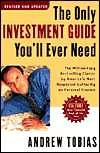
Is this really the only investment guide you'll ever need? Maybe not, but after reading a number of others, this is the one I rely on most, and return to again and again. The new edition of this guide, which was first published in 1978, includes updated facts and figures, the location of Web sites for the on-line investor, and some new anecdotes, but the advice it offers is basically the same, and remains as sound as ever.
What sort of advice? Don't buy mutual funds that charge "loads." Think twice before buying a closed-end fund at a premium. Don't wait for the market to drop before investing, but start slowly if it seems high. Put everything you can into tax-sheltered accounts such as IRAs and 401(k)s. Don't speculate in commodities: you'll lose your shirt. And don't underestimate the power of budgeting and stockpiling: if you get a discount buying wine by the case, for instance, you can make more on your wine investment than you would in the riskiest and most aggressive mutual funds.
Yes, there are other books that would give you the same advice, but this one is written by an author who has made his share of investment mistakes, has learned from them, and clearly relishes the absurdities of the financial world. His prose style is breezy but never sloppy, and he is refreshingly willing to name names. (See, for instance, his dissection of the dubious life-insurance plans promoted by such seemingly trustworthy types as Gavin McLeod and Dick Van Dyke.)
"Trust No One," the title of one chapter, was Tobias's motto long before The X-Files made it popular. Unlike many financial advisers who earn their livings by convincing you that investment is too complicated for ordinary mortals, Tobias is a confirmed do-it-yourselfer:
The stock market could hardly be simpler. There are just two ways a stock can go: up or down. There are just two emotions that tug in those opposite directions: greed and fear. There are just two ways to make money on a stock: dividends and capital gains. And there are just two kinds of investors in the market: the "public," like you or me; and the "institutions," like mutual funds and pension funds. It's the amateurs against the professionals, and it's not all that clear who has the advantage. Often, both lose.
"The bottom line," Tobias continues, "if you want to cut straight to the chase, is that you should do your stock-market investing through no-load mutual funds." Why? Because they make it possible to buy, sell, keep records, and diversify your holdings much more conveniently and cheaply than you could do on your own. Which no-load funds should you buy? This book doesn't attempt to say, though it does direct the reader to four of the most successful purveyors of low-cost funds: Vanguard, Mutual [now owned by Franklin Templeton], Twentieth Century [now American Century], and T. Rowe Price.
If the prospect of picking the "right" funds still seems too daunting, Tobias offers the simplest possible solution: an index fund. Index funds, a Vanguard specialty, are designed to passively track a segment of the stock market (typically the large US companies of the S&P 500) while incurring minimal management expenses. By achieving average results at below-average costs, index funds are practically guaranteed of beating most of the competition, year after year. As the author puts it, "This is a very simple concept but profound: just by investing all the money you have earmarked for the stock market in the Vanguard Index Trust, you will generally do better than most bank trust departments, mutual fund managers, and private investors -- with far less effort."
Questions remain, of course. Should you dump a lot of money into an S&P 500 fund right now, when the US stock market may be peaking after last year's extraordinary run-up? Should you use index funds for small-cap stocks or foreign stocks, where some believe that the opportunities are greater for active stock-picking? Investing is complicated, but it's not rocket science, and this book's most valuable lesson may be that you are probably capable of answering such questions on your own. "By and large," Tobias says, "you should manage your own money (via no-load mutual funds). No one is going to care about it as much as you. And no one but you is going to manage it for free."
Published in the Harvard Post, August 2, 1996.